VISUAL DEVELOPMENT ENVIRONMENT
Build software beyond the boundaries of code.
Elll is an integrated development environment that brings visual design, TypeScript, and AI-assisted programming into a unified workflow.
Design interfaces on an interactive canvas. Work directly with source code. Use AI agents to modify your project. Build and deploy applications through an integrated development infrastructure.
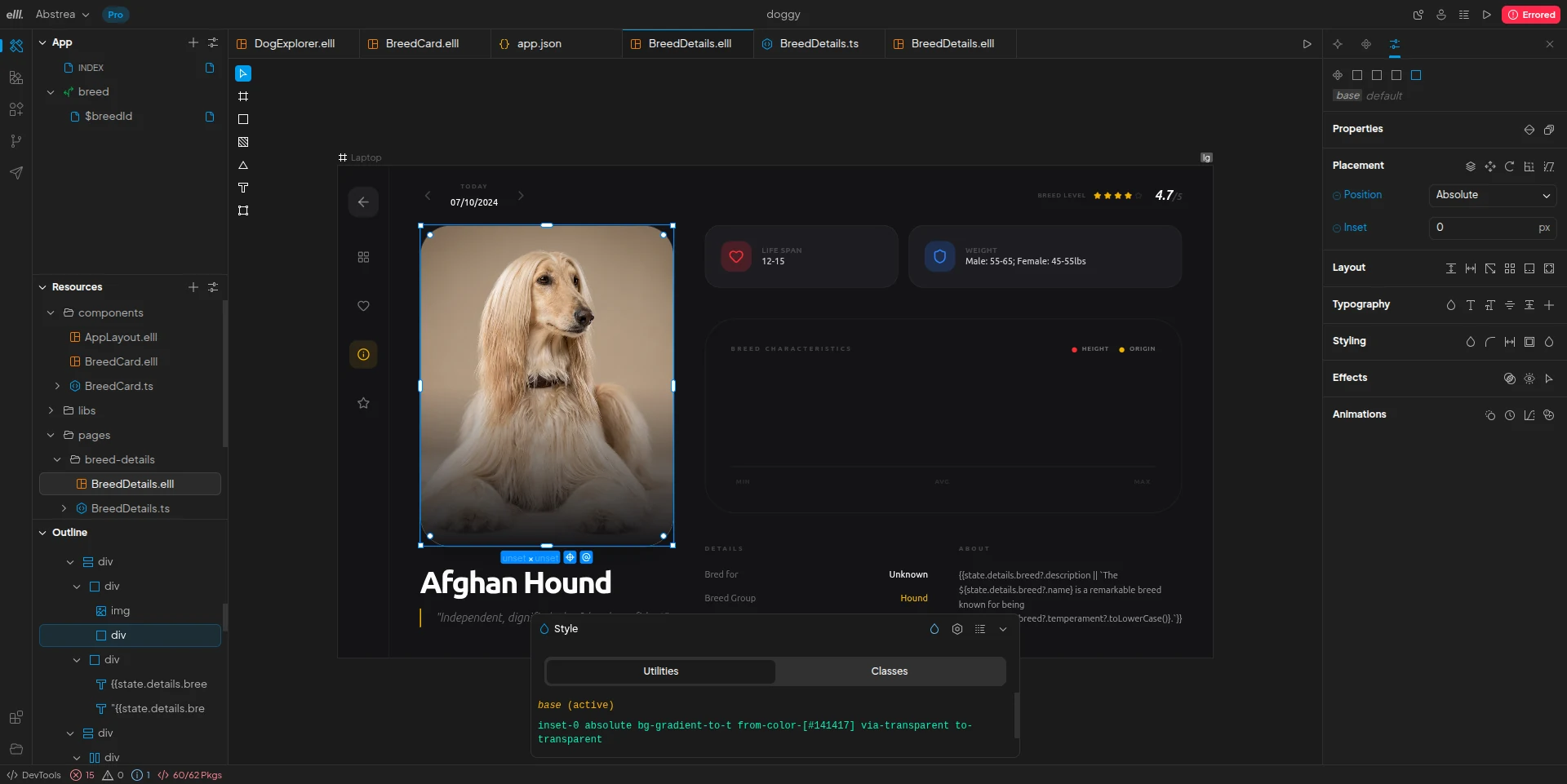
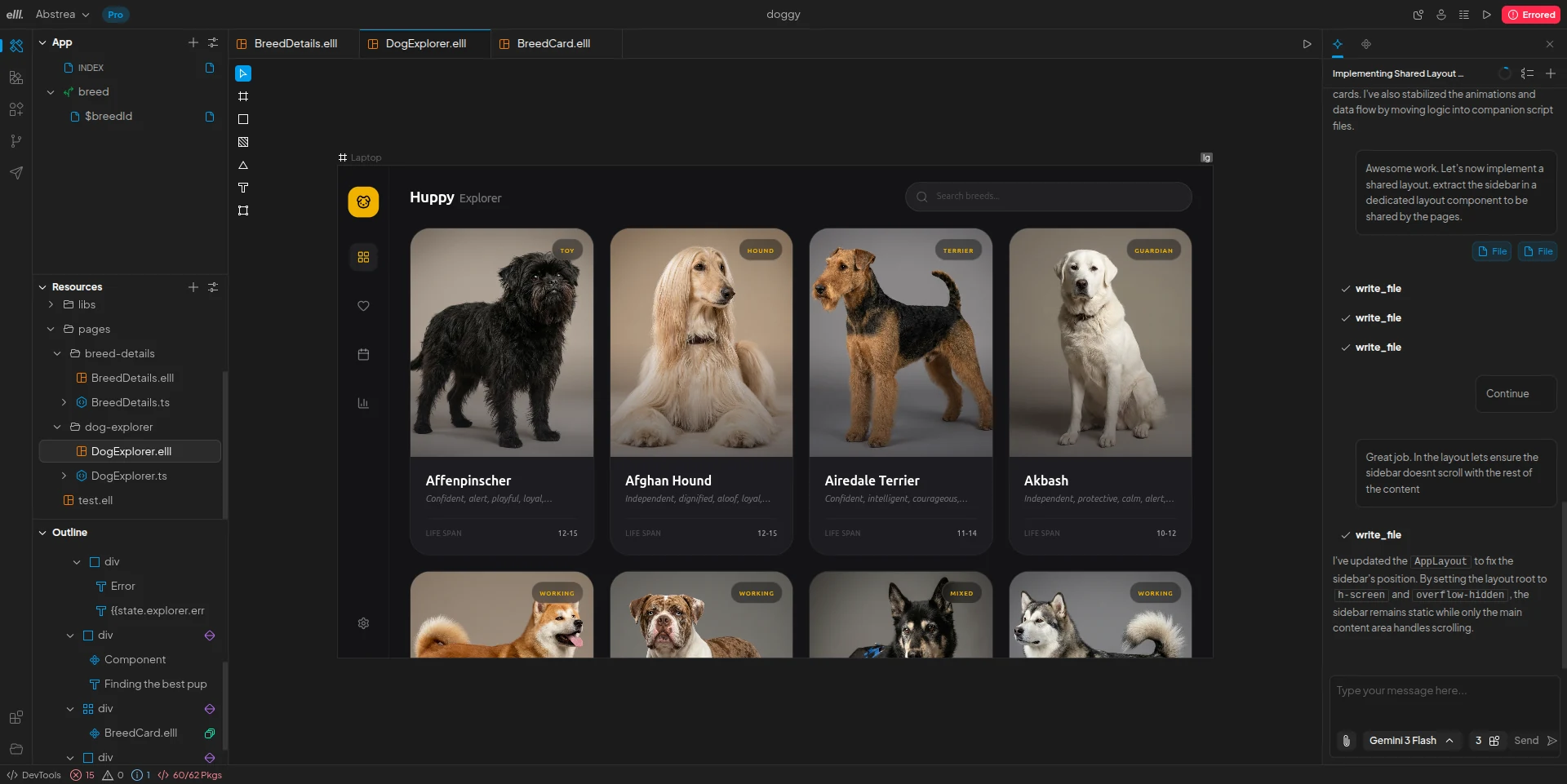
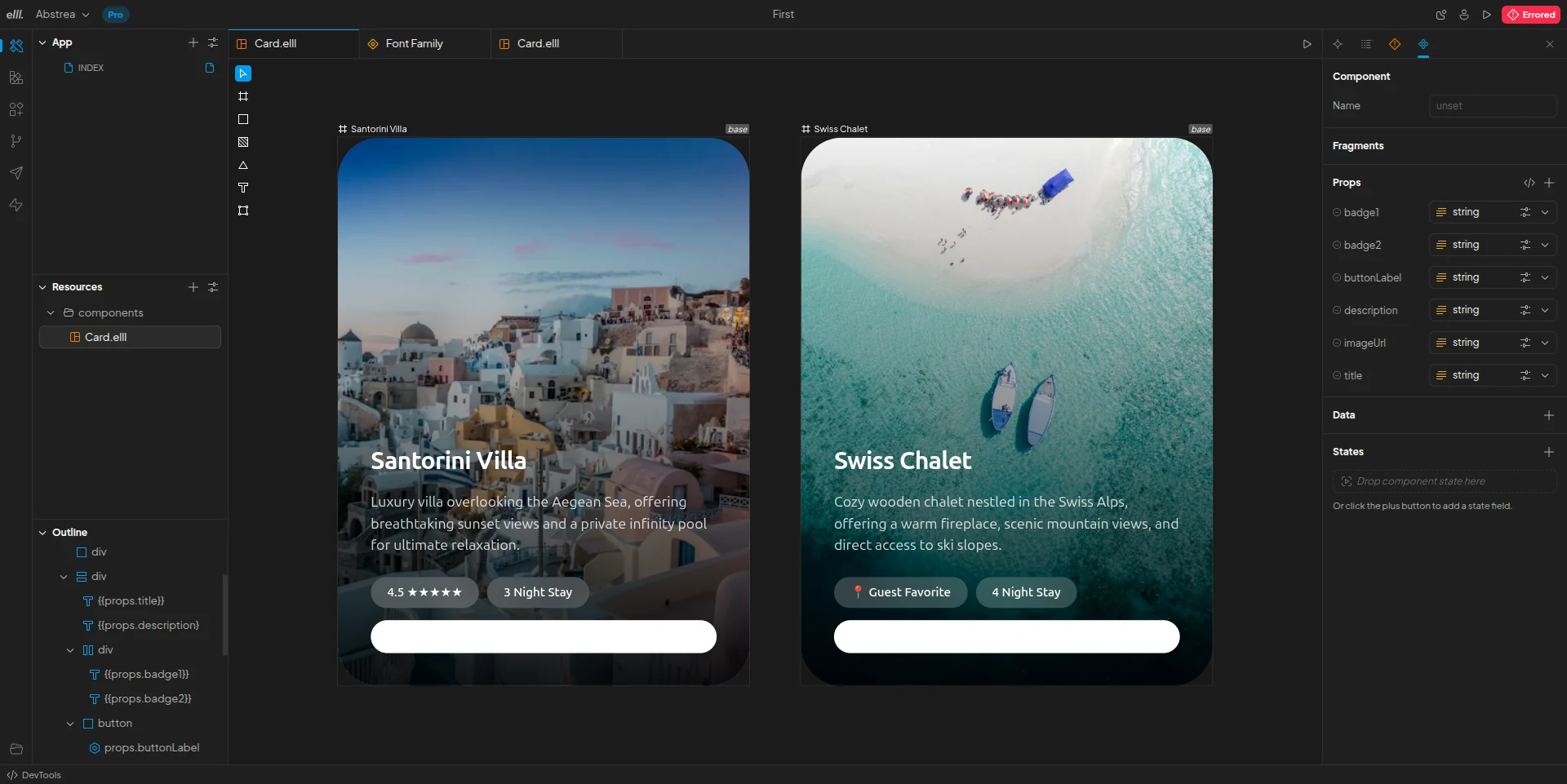
Visual canvas
Design on a live canvas wired to your real application structure.
01 — 04
THE PLATFORM
One environment. Multiple ways to build.
Traditional development environments treat design, programming, and deployment as separate activities. Elll brings them into one connected environment: a programmable visual editor, an application framework, source-code tooling, and cloud infrastructure.
Elll does not replace code with visual abstractions. It makes visual development and programming complementary ways of working with software.
Visual by nature
A canvas-based editor for creating and manipulating application interfaces directly.
Programmable by design
A TypeScript-based component system that connects structured application models with executable code.
AI-assisted
An integrated coding assistant with tools for inspecting, creating, and modifying project resources.
Built to ship
Application generation, build pipelines, server-side rendering, and deployment infrastructure designed as part of the platform.
THE EDITOR
A visual editor built on real code.
Elll's editor is built on Elementa, an application modeling and rendering engine. Interfaces are organized into programmable components, elements, styles, and resources, and an AST-based transformation layer keeps that structure and its TypeScript source in sync.
It runs in the browser as a configurable workspace, so you can move between the canvas, source code, project resources, and application previews.
Direct manipulation
Select, move, resize, and align elements on a canvas with frames, responsive layouts, and dedicated style controls, all while preserving the structure of the application.
Components, not mockups
Reusable components backed by structured definitions, with nested elements, properties, state, and references to other resources.
Source and structure, both ways
TSX component definitions are parsed into models the editor can manipulate, and changes are generated back into executable source.
Preview in context
Inspect individual components or preview application routes without leaving the environment.
Source-code editing
Monaco-based editing with TypeScript tooling and workspace-aware file models.
Extensible by architecture
A modular extension system registers editors, tools, views, and commands, with Web Workers handling transformations and TypeScript services off the main thread.
Visual editing and programming are designed to coexist in one workflow.
INTELLIGENCE
AI that works inside the development environment.
Elll integrates an AI coding assistant directly into the IDE. Rather than operating as an isolated chat interface, the assistant has tools that interact with the workspace and application structure.
Agent-driven workflows
An iterative execution engine coordinates model responses, tool calls, and their results, so agents can take multiple actions within one conversation.
Workspace-aware tools
The assistant can interact with the development environment through tools for:
- Reading files and directories
- Creating and modifying source code
- Inspecting and updating application routes
- Managing project packages and resources
Multiple model providers
Language models from OpenAI, Anthropic, and Google through a common integration layer.
Observable execution
Agent actions, intermediate results, errors, and execution states are shown within the IDE, so you can see what an agent is doing.
AI assistance is integrated into the development workflow, not added as an afterthought.
SYSTEM ARCHITECTURE
An integrated platform, built from the foundations up.
Elll is composed of interconnected systems for modeling applications, editing source code, executing development tools, building artifacts, and delivering applications. Each subsystem addresses a different part of the development lifecycle.
- 01
Elementa Engine
A structured foundation for visual applications.
Elementa provides the application models, reactive state, rendering abstractions, and interaction mechanisms used by the visual editor.
Its component and element representations connect the editing experience with the underlying application framework.
- 02
Code Transformation Engine
Bridging source code and structured representations.
An AST-based transformation system parses supported TSX component definitions and generates source code from structured models.
The transformation layer also supports component analysis and refactoring operations.
- 03
Workspace & Version Control
A file system designed around stable identity.
Each file has a stable identifier that stays distinct from its path. A custom version-control system builds on it with content-addressed storage, hierarchical records, commits, and diffs.
Browser-side caching with IndexedDB and background workers keeps file contents close and reduces remote requests.
- 04
Build Engine
A programmable pipeline for application delivery.
Builds run as declarative pipelines of tasks. A dependency-aware planner orders them, and a runner coordinates execution, outputs, errors, and lifecycle events.
Tasks execute in isolated Deno processes with configurable permissions, schema validation, and structured outputs passed to later stages.
- 05
Application Runtime
From structured applications to executable software.
Elll's application framework provides routing, components, server handlers, and runtime abstractions.
The build process generates client bundles, server-side rendering functions, and route configurations.
- 06
Deployment Infrastructure
The final step from development to delivery.
Deployment services coordinate artifact publishing, function deployment, static asset storage, and request routing.
Deployment manifests describe how application routes map to static resources and executable handlers.
HOW IT CONNECTS
From idea to application.
Elll brings together the tools and infrastructure involved in developing a web application, so design, code, AI, and delivery are never separate workflows.
01 / Create
Build an interface visually or work directly with its source code.
02 / Develop
Organize components, manage application routes, define styles, and use AI-assisted tools to modify project resources.
03 / Preview
Run and inspect the application within the development environment.
04 / Version
Track changes to project resources and capture application states through the integrated version-control system.
05 / Build
Execute a configured pipeline to transform application resources into executable artifacts.
06 / Deploy
Publish generated assets and server functions through the deployment infrastructure.
Visual. Programmable. AI-assisted. Integrated.
That's what Elll is built to do.
Interested in building on Elll?
Elll brings together visual programming, AI-assisted development, and integrated application infrastructure.
Whether you're interested in applying the technology to a specific problem, discussing a commercial partnership, or collaborating on its development, we'd love to hear from you.